How to Choose Industrial Waste Compactors?
Choosing Industrial Waste Compactors is not merely a matter of selecting the largest machine. It is a decision about material flow, labor safety, floor space, collection frequency, and long-term operating cost. A steel drum, cardboard bale, or wet food-waste load behaves differently inside a compactor. The wrong specification can create blockages, excessive wear, or avoidable downtime.
The scale of the challenge is growing. The World Bank’s What a Waste 2.0 report projects global municipal solid waste to reach 3.40 billion tonnes annually by 2050. The U.S. Environmental Protection Agency reported 292.4 million tons of municipal solid waste generated in 2018. These figures underline a practical need: facilities must reduce waste volume before transport wherever suitable. Silpa Kaza, lead author of What a Waste 2.0, stated, “There is no one-size-fits-all solution.” That warning applies directly to compactor selection.
A reliable assessment starts beside the loading point. Measure container dimensions, waste density, moisture, peak volumes, and available electrical capacity. Then compare hydraulic force, chamber size, cycle time, noise, access, and maintenance support. A machine that looks efficient on paper may struggle with saturated waste or irregular loading. That is the uncomfortable part. Perfect data is rare. Buyers should document assumptions and test representative materials before committing. This guide examines those decisions through an evidence-based, experience-led lens, helping managers balance throughput, safety, compliance, and total ownership cost without treating a compactor as a simple plug-in purchase.
Define the Types of Industrial Waste Compactors
How to Choose Industrial Waste Compactors?
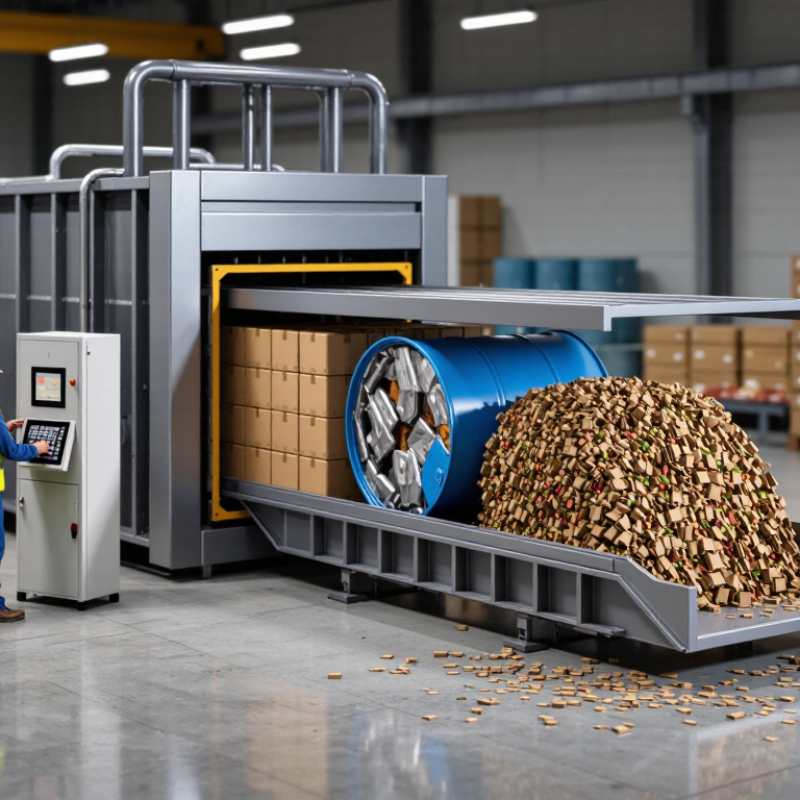
Defining the type is the first practical step when choosing an industrial waste compactor. Stationary compactors remain at the site while trucks remove the container. They suit factories, warehouses, and distribution centers with steady, dry waste. Self-contained compactors combine the compactor and container in one sealed unit. Their enclosed design helps control liquids, odors, and leaks near food-processing areas. They often require more careful drainage and cleaning routines.
Vertical compactors use limited floor space and work well in retail back rooms or small facilities. Horizontal compactors handle larger waste volumes and support continuous loading in busy production areas. Pre-crusher compactors reduce bulky materials before final compaction. They can manage pallets, drums, and rigid packaging, but they need stronger floors and more clearance. Every type has limits.
Site experience matters here. Measure the loading area, doorway height, truck access, and available electrical supply. Check the waste stream during a normal week, not only on a quiet day. Moisture, cardboard volume, and oversized items can change the best choice. A common mistake is selecting by capacity alone. In practice, no type is perfect. I would also review noise, cleaning access, operator safety, and service intervals. A smaller compactor may perform better when workers load it frequently and safely. Specification sheets help, but real workflow observations often reveal the better fit.
How to Choose Industrial Waste Compactors?
Define the Types of Industrial Waste Compactors
Compaction performance depends on the waste material, moisture content, loading method, and machine design. Vertical compactors are commonly selected where floor space is limited, while stationary compactors suit high-volume dry waste. Self-contained compactors are designed for wet waste, and mobile compactors are useful when flexible placement is required. The ranges shown represent typical industry volume-reduction results rather than guaranteed machine performance.
Assess Waste Materials, Volume, and Operating Conditions
Start with the waste itself. Material type determines compactor suitability, loading method, and maintenance needs. The World Bank’s What a Waste 2.0 report estimates that global municipal waste generation reached 2.01 billion tonnes annually. Industrial streams add different challenges, including wet residues, packaging, scrap materials, and process by-products.
Separate materials by density, moisture, abrasiveness, and contamination risk. Cardboard may compress easily, while wet organic residue can create leakage, odors, and heavy loads. Do not rely only on estimated volume. Measure daily output for at least one operating week, including peak production days. The U.S. Environmental Protection Agency reported 292.4 million tons of municipal solid waste in 2018, or about 4.9 pounds per person daily. That figure shows why average volumes can hide significant fluctuations. A spreadsheet alone can mislead.
Operating conditions matter just as much. Check available floor space, vehicle access, electrical supply, drainage, temperature, and cleaning routines. A compactor placed beside a washdown area may need stronger corrosion protection and sealed components. High-cycle operations require careful review of duty ratings and service intervals. Dusty locations need suitable guarding and inspection procedures. Workers should also have clear loading and lockout procedures. Keep it practical. Test before buying. A short material trial can reveal bridging, leakage, or uneven compaction that specifications miss. My imperfect assumption would be choosing the largest machine first; capacity without matching material behavior can increase cost and reduce reliability.
Match Compactor Capacity and Features to Facility Needs
How to Choose Industrial Waste Compactors?
Compactor selection should begin with waste volume, not machine size. The U.S. Environmental Protection Agency reported 292.4 million tons of municipal solid waste in 2018. That equals about 4.9 pounds per person daily. A busy facility can exceed its estimates quickly.
Measure waste from normal and peak operating days. Record container fills, collection frequency, material types, and available floor space. Then match capacity to the heaviest realistic load. A small unit may require frequent pickups, increasing labor and transport costs. An oversized unit can waste energy and occupy valuable production space. Bigger is not automatically better.
Material changes the equipment decision. Cardboard, packaging film, food waste, and wet refuse compact differently. Ask for a trial using your actual waste stream. The World Bank’s What a Waste 2.0 report estimated 2.01 billion tonnes of municipal waste globally in 2016, with 3.40 billion tonnes projected by 2050. Future volume matters.
Look for controls that prevent unsafe access, simple cleaning points, overload protection, and clear fill-level monitoring. Noise and cycle time also affect workers near the loading area. A neat spreadsheet is not enough. My practical mistake was trusting average volume while ignoring Monday peaks and seasonal shipments. Review the figures after installation. Data can expose a poor assumption.
Compare Power Systems, Safety Measures, and Maintenance Demands
Choosing an industrial waste compactor requires more than comparing pressing force. Its power system shapes energy use, noise, response time, and service risk. Electric-hydraulic units suit fixed sites with stable grid access. Diesel-hydraulic machines offer mobility but add fuel storage, exhaust control, and engine servicing. Pneumatic systems can work in hazardous dust zones, yet compressed-air losses matter. The U.S. Department of Energy reports that leaks may waste 20–30% of compressor output. That figure can quietly increase operating costs.
Safety deserves equal weight. Check guarding around the ram, hopper, access doors, and discharge area. Interlocked doors should stop motion before an operator reaches the chamber. OSHA’s machine-guarding rules require protection from points of operation and moving parts. Lockout/tagout controls are also essential during clearing or inspection. They are not optional paperwork. A visible isolation switch helps, especially during night shifts.
Maintenance demands often decide the real purchase cost. Ask for access to hydraulic filters, hoses, sensors, and lubrication points without climbing over packed waste. Record oil temperature, cycle time, unusual vibration, and seal leakage. NFPA 70B identifies documented electrical maintenance as a key reliability practice. Still, preventive schedules are not perfect. Dust, moisture, and overloading can shorten service intervals. A practical trial should measure daily cycles, cleaning time, and technician access. Fancy controls may impress, but simple diagnosis often saves more downtime.
How to Choose Industrial Waste Compactors? - Compare Power Systems, Safety Measures, and Maintenance Demands
| Compactor Type | Typical Power System | Typical Compaction Force | Suitable Waste and Applications | Key Safety Measures | Maintenance Demand | Main Selection Considerations |
|---|---|---|---|---|---|---|
| Stationary Hydraulic Compactor | Electric motor driving a hydraulic pump; commonly supplied from a three-phase electrical system. | Approximately 20–60 tonnes, depending on cylinder size and machine configuration. | General industrial waste, packaging, cardboard, plastics, and high-volume dry waste loaded into a separate container. | Interlocked loading door, emergency stop, guarded ram area, automatic cycle control, and lockout/tagout provisions. | Moderate; requires hydraulic-fluid checks, hose and seal inspection, filter service, lubrication, and electrical checks. | Available electrical capacity, waste volume, container compatibility, floor loading, and required throughput. |
| Self-Contained Hydraulic Compactor | Electric-hydraulic power unit integrated with a sealed receiving container. | Approximately 20–50 tonnes for common industrial and commercial configurations. | Wet waste, food waste, medical-related non-sharps waste, and materials that may release liquids or odors. | Sealed container, leak-resistant door seals, access interlocks, emergency stop, ram guarding, and wash-down procedures. | Moderate to high; includes hydraulic maintenance plus frequent cleaning, odor control, seal inspection, and corrosion checks. | Liquid retention, drainage arrangements, hygiene requirements, collection frequency, and corrosion resistance. |
| Vertical Baler-Compactor | Electric-hydraulic system with a vertical compression chamber and manual or semi-automatic tying. | Approximately 10–60 tonnes, depending on the bale size and material type. | Cardboard, paper, film, textile waste, and other dry recyclable materials that can be tied into bales. | Two-hand controls or guarded controls, interlocked chamber door, ram restraint, emergency stop, and safe bale-ejection design. | Low to moderate; routine lubrication, hydraulic inspection, electrical checks, door-interlock testing, and tie-wire replacement. | Available floor and ceiling space, bale weight, operator handling, material segregation, and recycling requirements. |
| Horizontal Channel Baler | Electric-hydraulic power system; automatic wire or strap tying may be available on higher-throughput configurations. | Approximately 40–150 tonnes for industrial recycling applications. | Large volumes of cardboard, paper, plastics, textile waste, and other dry recyclable materials. | Hopper guarding, conveyor protection, access-door interlocks, emergency pull cords, jam-clearing procedures, and lockout/tagout. | High; requires planned servicing of hydraulics, conveyors, sensors, tying equipment, cutting components, and safety devices. | Continuous feed rate, available labor, bale density, utility capacity, material contamination, and equipment integration. |
| Mobile Towable Compactor | Electric-hydraulic system with a towable chassis; some specialized units use engine-driven hydraulics. | Approximately 15–40 tonnes for general waste and transfer-point applications. | General waste, packaging waste, construction-site waste, and locations where equipment must be repositioned. | Tow-bar and wheel chocks, parking brakes, stable positioning, guarded moving parts, emergency stop, and traffic separation. | Moderate to high; includes hydraulic and electrical checks plus tires, brakes, lights, chassis, tow connections, and structural inspection. | Site mobility, road or yard conditions, towing regulations, power availability, positioning time, and load stability. |
| Pneumatic Compactor | Compressed-air cylinders supplied by a plant air compressor; generally suited to lighter-duty applications. | Typically lower than hydraulic systems; often approximately 5–20 tonnes, depending on cylinder diameter and air pressure. | Light packaging waste, small-volume production waste, and facilities that already have suitable compressed air. | Guarded cylinders, pressure regulation, relief protection, emergency stop, air isolation, and safe pneumatic lockout procedures. | Moderate; requires air-filter and moisture management, leak testing, cylinder-seal inspection, lubrication, and hose replacement. | Available air pressure and flow, compressor capacity, noise, force requirements, duty cycle, and energy cost. |
| Diesel-Hydraulic Compactor | Diesel engine driving a hydraulic pump; used where grid electricity is unavailable or mobility is essential. | Approximately 20–60 tonnes for heavy-duty mobile or remote-site configurations. | Remote construction sites, disaster-response operations, transfer areas, and temporary waste-handling locations. | Engine guarding, exhaust and fire protection, emergency stop, hydraulic guarding, safe refueling, and ventilation controls. | High; requires engine servicing, fuel-system care, hydraulic maintenance, battery checks, exhaust inspection, and emissions compliance. | Fuel access, emissions limits, noise restrictions, operating hours, mobility needs, and total operating cost. |
Evaluate Installation Costs, Efficiency, and Long-Term Value
How to Choose Industrial Waste Compactors?
Installation cost is more than the equipment price. Inspect the site before comparing quotations. Check floor strength, doorway width, power supply, drainage, and service access. A unit may fit the room but block a forklift route. That mistake is expensive. Include electrical work, concrete preparation, delivery, commissioning, and staff training in the budget. Experienced facility managers also request maintenance schedules and warranty terms in writing. These details reveal the real ownership cost.
Tips: Measure the waste area twice. Record weekly waste volume, container changes, labor hours, and hauling charges. Then estimate the payback period using realistic figures, not optimistic forecasts. Ask for noise levels, cycle times, energy use, and recommended service intervals. A compactors’ purchase price can look attractive, yet frequent repairs may erase the savings. Small sites should also consider clearance around the loading opening. Safe access matters.
Efficiency should match the waste stream. Cardboard, packaging, and mixed dry waste may require different pressure settings and chamber sizes. Overloading reduces performance and can damage components. Underusing a large machine wastes capital and floor space.
Request performance data from technical documents, then compare it with your own records. Long-term value depends on reliable cycles, accessible parts, operator safety, and adaptable controls. I have seen projects focus too heavily on compression force. Later, labor movement and maintenance access became bigger problems. That is worth reconsidering before approval.
Related Posts
-
What Are the Top Waste Compactor Types in 2026?
-
7 Tips for Finding a Trash Compactor Near Me?
-
Essential Checklist for Choosing the Right At Home Trash Compactor for Your Waste Management Needs
-

How Chinese Manufacturing Thrives Despite US-China Tariff Challenges: The Rise of the Best Home Compactor
-
Global Excellence in Home Trash Compaction: China’s Pride in Exporting Innovative Solutions
-
Exceptional Manufacturing Excellence from China's Leading Factory for the Best Trash Compactor for Recycling