How to Choose the Right Injection Machine Robot for Your Needs?
Selecting the right Injection Machine Robot is crucial for any manufacturing process. These robots enhance efficiency and precision in production. However, the options available can be overwhelming.
Different industries have unique needs. Some require speed, while others prioritize accuracy. It can be challenging to find a balance between these factors. You may wonder if the automation level meets your production goals. Assessing your specific requirements is vital.
Budget is another critical factor. High-end models may promise advanced features but may not fit every company’s financial plan. Consider the long-term benefits, too. Sometimes, investing in a quality Injection Machine Robot may lead to cost savings. Take your time to reflect on what suits your operation best.
Understanding Different Types of Injection Machine Robots
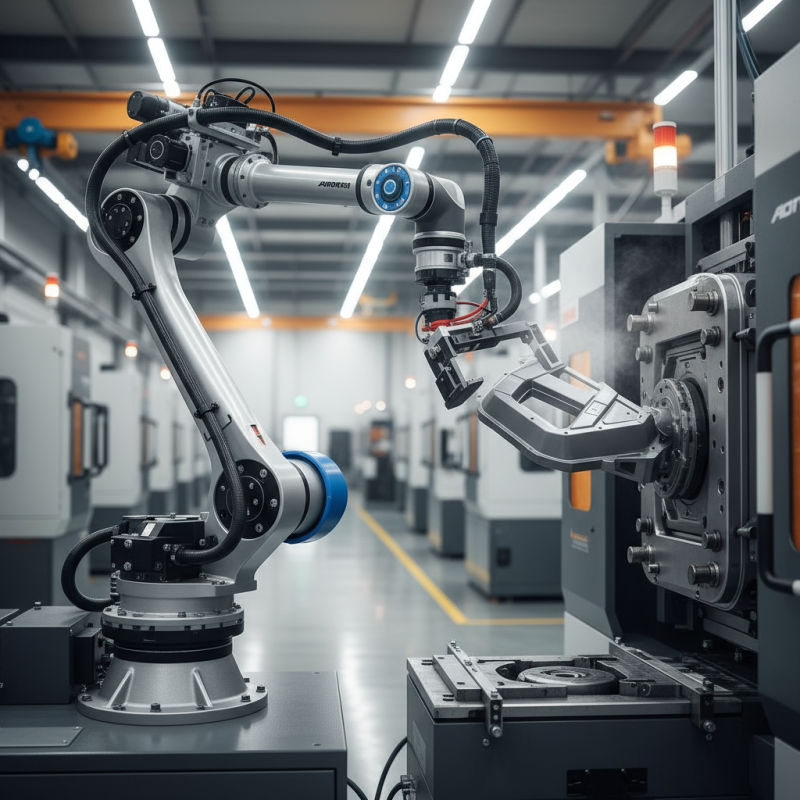
Injection machine robots come in various types, each designed for specific applications. Common options include articulated robots, SCARA robots, and Cartesian robots. Articulated robots are known for their flexibility. They work well in complex tasks, offering freedom of movement. Reports suggest they can improve efficiency by up to 30% in certain assembly lines.
SCARA robots excel in high-speed operations. They are perfect for tasks like pick-and-place or packaging. These robots have a unique four-axis design. This allows them to perform repetitive tasks quickly and reliably. According to industry studies, SCARA robots can decrease cycle times by nearly 25%.
Cartesian robots, or gantry systems, are built for precision. They are ideal for materials handling and assembly tasks. Their linear motion leads to high accuracy, which is crucial in sectors like electronics. Nonetheless, these systems can have a larger footprint and limited flexibility. Choosing the right robot involves knowing your specific needs, limits, and space constraints. Each type has its advantages and limitations. Careful consideration is essential to maximize productivity and efficiency.
Injection Machine Robot Types and Their Applications
Assessing Your Production Requirements for Robot Selection
When selecting an injection machine robot, understanding your production needs is essential. Start by assessing the volume of production you expect. High-volume environments may require faster robots. Slower settings might benefit from more precise machines. Think about the types of materials you will use. Different materials may require different handling. A robot optimized for one material may not perform well with another.
Consider the layout of your workspace, too. A machine that fits well in a cramped space can significantly enhance efficiency. Reflect on any existing automation systems you have. Compatibility is key for seamless operation. Think about your team’s skill level as well. A complex robot can be challenging to operate and require additional training.
Evaluate your current production cycle times. A robot that speeds up production should align with your quality standards. It’s important to balance speed with precision. Sometimes, maximizing output can lead to mistakes. Consider your budget as well. Finding an affordable robot that meets all criteria can be difficult. Always weigh your options and revisit your choices as your production needs evolve.
Evaluating Key Features and Specifications of Injection Robots
Choosing the right injection machine robot involves careful evaluation of key features. Begin with the payload capacity. This determines how much weight the robot can lift and position effectively. If the application involves heavy molds, ensure the robot can handle this without strain. Speed is also crucial. Look for robots that offer quick cycle times to boost productivity. However, faster isn't always better if it compromises precision.
Consider the degree of flexibility. Some robots can be programmed for various tasks, while others may be more limited. This flexibility can be a double-edged sword; versatile robots might require more complex programming. Think about the ease of integration as well. Does the robot work well with existing equipment? If not, integration can become a headache down the line, leading to additional costs and time delays.
Lastly, assess the software capabilities. User-friendly interfaces make operation easier, but advanced software features might be necessary for complex processes. Balancing simplicity with functionality is essential. There's always room for improvement when selecting features. Reflect on your specific needs and be open to revising your choice based on real-world applications and feedback.
How to Choose the Right Injection Machine Robot for Your Needs? - Evaluating Key Features and Specifications of Injection Robots
| Feature | Specification | Importance |
| Payload Capacity | 5-100 kg | High |
| Arm Reach | 500-2000 mm | Medium |
| Repeatability | ±0.1 mm | High |
| Speed | 250-800 mm/s | Medium |
| Power Consumption | 1-5 kW | Medium |
| Control System | Programmable Logic Controller (PLC) | High |
| Integration Compatibility | Compatible with various injection molding machines | High |
| Safety Features | Emergency stop, safety sensors | High |
Comparing Cost and Budget Considerations for Injection Robots
When selecting an injection machine robot, cost is a critical factor. Industry reports indicate that the price of these robots can vary significantly. Basic models may start around $25,000, while advanced options can exceed $100,000. This disparity often hinges on functionality, speed, and precision.
Budget considerations are essential. The lifetime savings from energy efficiency can offset initial costs. According to a recent study, energy-efficient robots can reduce operational costs by up to 30%. However, unexpected maintenance fees and software updates should factor into your budget. These hidden costs can accumulate, making it vital to inquire about warranty and support options.
Choosing the right machine involves weighing upfront costs against potential savings. Sometimes, more expensive robots deliver better long-term value. Evaluating each aspect ensures that the investment is sound. Yet, it's easy to overlook factors like usability or specific application needs during decision-making. Regularly reviewing your choice can lead you back to the drawing board.
Researching and Reviewing Trusted Manufacturers and Models
When selecting an injection machine robot, thorough research is vital. Start by identifying reputable manufacturers. Look for those with positive reviews and a solid track record. Online platforms and industry forums can provide valuable insights. Engage with users who have experience with different models. Their first-hand accounts can highlight both strengths and weaknesses.
Pay attention to specific features that suit your needs. Different models offer varying capabilities, like speed and precision. Some may excel in small-scale production, while others handle larger volumes. It’s crucial to assess whether a machine meets your operational demands. Also, consider the support and training provided by the manufacturer. Many users overlook post-purchase assistance, which can affect the machine’s performance.
Reflect on your long-term goals as well. A robot that fits your current needs might not suffice in the future. Evaluate how flexible the machine is for upgrades or modifications. Not accounting for future growth can lead to underperformance or unnecessary costs later on. Avoid rushing, as the right choice now can lead to increased productivity and satisfaction down the road.