
How to Choose the Best PE Filler Masterbatch?
Choosing the best PE Filler Masterbatch is not simply a price comparison. It is a material decision that affects processing, appearance, strength, and production stability. A suitable grade should match the polymer, filler level, end product, and equipment settings. The correct choice for blown film may fail in injection molding. Small details matter.
Experienced buyers usually examine calcium carbonate purity, carrier resin compatibility, moisture content, particle dispersion, and recommended dosage. They also request a technical data sheet and a recent certificate of analysis. During a practical trial, observe melt pressure, film thickness, surface smoothness, tensile strength, and elongation. A 25-kilogram bag can look consistent, yet poor dispersion may create visible specks or weak points. These problems often appear after several hours of continuous production.
Reliable evaluation requires more than one test. Compare samples under identical temperatures, screw speeds, cooling conditions, and filler ratios. Check whether the supplier explains quality controls clearly and supports traceable batch testing. Compliance with applicable product, packaging, and environmental requirements should also be confirmed for the target market. Not every low-cost grade wins. A cheaper masterbatch may increase scrap, cleaning time, or rejected rolls.
There is no universal formula. A filler level that works for shopping bags may reduce impact strength in a thicker molded part. Even experienced teams can overlook humidity, storage time, or a small change in resin grade. That is why documented trials and honest review remain essential. The best PE Filler Masterbatch balances performance, consistency, cost, and the real demands of your process.
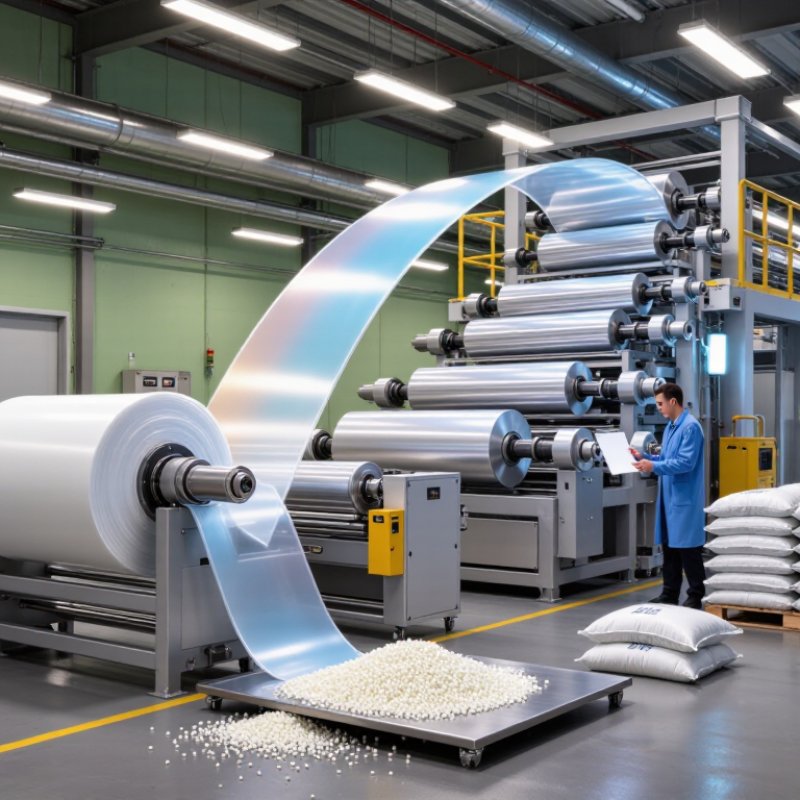
What Is PE Filler Masterbatch and How Does It Work?
PE filler masterbatch is a concentrated blend of polyethylene carrier resin and mineral filler, commonly calcium carbonate. The carrier helps distribute filler through the polymer during extrusion. Heat and shear open the pellets, then the filler spreads across the melt. This can reduce resin use, increase stiffness, improve opacity, and control shrinkage. However, it also raises density and may reduce impact strength if dispersion is poor.
According to Plastics Europe’s Plastics—The Fast Facts 2023, global plastics production reached 400.3 million tonnes in 2022. That scale explains the interest in material efficiency, but filler is not a universal solution. A practical trial might use a 70% calcium carbonate masterbatch at 10% let-down. The final compound then contains about 7% mineral filler. Check melt flow, moisture, tensile strength, elongation, and surface appearance before approval. ISO 1133 melt-flow testing and ISO 527 tensile testing provide useful comparison points. Still, laboratory results may not predict every production problem.
Tips: Match the carrier resin with the target PE grade. Check filler particle size and surface treatment. Use dry storage and stable feeding equipment. Watch for brittle edges, die buildup, or white streaks. A cheaper formulation can become expensive after rejected rolls. I have seen this overlooked. The “best” masterbatch depends on the product, process temperature, and required balance between cost and performance.
Which Properties Matter When Choosing PE Filler Masterbatch?
Choosing PE filler masterbatch starts with the finished product, not the lowest price. A film, crate, and extrusion sheet need different performance balances. Check filler type, mineral purity, particle size, and carrier resin compatibility. Fine particles can improve surface uniformity when dispersion remains stable. Poor dispersion creates specks, weak points, and uneven gloss.
Melt flow rate deserves close attention. It affects feeding, mixing, cycle time, and final thickness. Compare the masterbatch with your PE grade and processing temperature. Moisture is another practical concern. Even small amounts can cause bubbles, silver streaks, or unstable output. Request current data for ash content, moisture, density, and batch variation. A certificate alone is not enough. Trial samples matter.
Mechanical properties must match the product’s real load. Higher filler content may reduce elongation or impact strength, despite lowering resin consumption. Test tensile strength, tear resistance, stiffness, and drop performance after conditioning. Optical properties also matter in thin film. Opacity, whiteness, and surface appearance can change with screw speed and cooling conditions. I once accepted a formulation after a short bench test, but continuous production exposed pressure fluctuations and surface defects. That mistake still influences how I evaluate new materials. Record pressure, torque, output, and defect rates during the plant trial.
How to Match Filler Masterbatch with Different PE Applications?
When choosing the best PE filler masterbatch, start with the application, not the lowest price. A film grade needs stable dispersion, controlled stiffness, and reliable sealing. A blown film line may also require low moisture and consistent melt flow. For injection molding, the priority often changes. The compound must fill the mold cleanly, reduce shrinkage, and maintain acceptable impact strength. Small differences become visible around thin ribs and corners.
For pipes, sheets, and extrusion profiles, check output stability and surface finish. The carrier resin should match the PE family and processing temperature. A mismatch can create specks, die build-up, or uneven gloss. Calcium carbonate content matters, but the highest loading is not automatically the best choice. I have seen a cheaper, heavily loaded grade increase brittleness and waste. That result was easy to miss during a short trial. Results can surprise.
Ask for technical data on particle size, moisture, melt flow, and recommended addition levels. Then test the masterbatch on the actual machine. Record pressure, torque, cooling time, tensile strength, elongation, and drop impact. Compare samples after storage, not only immediately after production. This catches weak dispersion and delayed brittleness. Some decisions remain uncertain. A laboratory result may not predict every operator setting or seasonal temperature change. Keep a small production trial, adjust loading gradually, and inspect both the product and the process.
How to Choose the Best PE Filler Masterbatch? - How to Match Filler Masterbatch with Different PE Applications?
| PE Application | Typical PE Grade | Recommended Filler Type | Typical Filler Loading in Masterbatch | Suggested Masterbatch Addition | Key Selection Parameters | Expected Functional Benefits | Main Risks and Controls |
|---|---|---|---|---|---|---|---|
| Blown Film for Shopping Bags and General Packaging | LDPE, LLDPE, or LDPE/LLDPE blends | Coated calcium carbonate Fine particle size | Typically 75–85% calcium carbonate by mass | Usually 5–15% of the total film formulation; validate through film testing | Good dispersion, controlled moisture, suitable melt flow, low agglomeration, and compatibility with the selected PE resin | Reduced resin consumption, increased stiffness, improved opacity, and potential cost reduction | Excessive loading can reduce elongation, tear strength, impact resistance, and dart-drop performance. Confirm tensile, tear, seal, and puncture properties. |
| Agricultural Film and Greenhouse Film | LLDPE or LDPE with film-grade melt flow | High-purity calcium carbonate UV-compatible formulation | Typically 70–80% calcium carbonate by mass | Generally 3–10%; the final level depends on required light transmission and film strength | Low impurity content, stable dispersion, controlled particle size, moisture control, and compatibility with UV stabilizer packages | Increased stiffness and opacity; selected mineral systems may also support light diffusion when the film design requires it | Mineral filler does not replace UV stabilization. Test weathering, tensile retention, haze, light transmission, and service-life performance. |
| Heavy-Duty Sacks and Woven Packaging | HDPE, PP/PE blends, or high-strength PE grades | Coated calcium carbonate Medium-to-fine particle size | Typically 70–80% calcium carbonate by mass | Usually 5–12% of the total formulation | High dispersion quality, low screen-pack pressure, suitable drawability, and consistent pellet feeding | Increased stiffness, improved dimensional stability, and reduced polymer usage | High filler levels may cause yarn brittleness, lower tensile strength, and breaks during tape extrusion. Check tensile strength, elongation, and weaving performance. |
| Blow-Molded Bottles and Containers | HDPE blow-molding grades | Fine calcium carbonate High-dispersion grade | Typically 70–80% calcium carbonate by mass | Normally 2–8%; lower levels are often preferred for demanding impact applications | Stable parison strength, low contamination, good melt homogeneity, and compatibility with bottle-wall thickness requirements | Improved rigidity, opacity, and dimensional stability in suitable non-pressure containers | Excessive mineral content can reduce impact strength and parison melt strength. Test top-load, drop impact, ESCR, wall distribution, and leakage performance. |
| Injection-Molded Household Articles | HDPE or LDPE injection-molding grades | Calcium carbonate Surface-treated mineral | Typically 70–85% calcium carbonate by mass | Commonly 5–20%, depending on surface appearance and mechanical targets | Melt flow compatibility, short-cycle processability, surface finish, low warpage, and balanced stiffness-impact performance | Increased stiffness, improved dimensional stability, reduced shrinkage, and possible cycle-time or material-cost benefits | Poor dispersion may create flow marks, weld-line weakness, visible specks, or mold deposits. Evaluate impact, shrinkage, warpage, gloss, and appearance. |
| Extruded Sheets and Thermoforming Products | HDPE, LDPE, or PE blends selected for sheet extrusion | Fine calcium carbonate High whiteness grade | Typically 75–85% calcium carbonate by mass | Usually 5–15% of the total formulation | Stable extrusion pressure, uniform dispersion, good sheet surface, controlled shrinkage, and adequate melt strength during forming | Increased rigidity, opacity, thickness stability, and improved dimensional control | Excess filler may reduce thermoforming elongation and cause surface roughness. Test heating behavior, draw ratio, impact, thickness uniformity, and surface quality. |
| Rotomolding Products | Rotomolding-grade LLDPE or crosslinkable PE systems | Very fine calcium carbonate Low-moisture grade | Typically 60–80% calcium carbonate by mass | Often 3–10%; formulation limits depend strongly on powder flow and impact requirements | Powder flow, particle-size distribution, moisture level, sintering behavior, melt homogeneity, and resistance to internal void formation | Improved stiffness, opacity, and dimensional stability where high impact strength is not the primary requirement | High mineral content may increase porosity, reduce impact strength, and affect fusion. Check bulk density, powder flow, wall thickness, impact, and internal voids. |
| PE Pipe and Profile Extrusion | HDPE or MDPE pipe and profile grades | High-purity calcium carbonate Application-specific grade | Typically 70–80% calcium carbonate by mass | Normally 2–8% for non-pressure profiles; pressure-pipe applications require separate qualification | Low contamination, controlled moisture, reliable dispersion, dimensional stability, and compliance with the product's mechanical and regulatory requirements | Increased stiffness and reduced shrinkage in suitable non-pressure products and profiles | Filler can reduce slow-crack-growth resistance, impact strength, and long-term pressure performance. Do not use an unqualified formulation for pressure pipe. |
| Cable Compounds and Wire Insulation | Insulation-grade LDPE, LLDPE, or specialty PE compounds | Low-moisture calcium carbonate High-dispersion grade | Typically 70–80% calcium carbonate by mass | Often 2–8%; the permitted level depends on electrical and flexibility requirements | Very low moisture, low ionic contamination, smooth extrusion, stable electrical properties, and adequate flexibility | Potential stiffness and cost benefits in suitable non-critical cable products | Moisture or ionic impurities can affect insulation performance. Test dielectric strength, volume resistivity, flexibility, surface smoothness, and aging performance. |
| Foamable PE Products | LDPE or EVA/PE systems designed for foaming | Fine calcium carbonate Controlled surface treatment | Typically 70–80% calcium carbonate by mass | Usually 2–8%; optimize against cell structure and density targets | Particle-size uniformity, moisture control, melt strength, compatibility with the blowing-agent system, and nucleation behavior | May improve cell nucleation and dimensional stability when properly formulated | Excess filler can increase density, damage cell uniformity, or reduce expansion. Measure foam density, cell size, compression set, and dimensional recovery. |
How to Evaluate Quality, Compatibility, and Cost Effectively?
How to Choose the Best PE Filler Masterbatch?
Choosing a PE filler masterbatch requires more than comparing calcium carbonate percentages. Quality begins with consistent particle dispersion, moisture control, and stable carrier resin. Request a technical data sheet, safety documentation, and recent batch records. Then inspect the pellets for uniform color, clean surfaces, and minimal dust. In production trials, examine film thickness, tensile strength, sealability, and surface appearance. A smooth-looking sample can still hide weak dispersion.
Tips: Start with a small trial batch. Keep the processing temperature stable. Compare the same dosage. Record melt pressure, output, and rejected parts. Ask for test methods, not only performance claims. I once focused too heavily on filler loading and overlooked poor feeding behavior. That mistake increased waste and slowed the line.
Compatibility affects both product quality and operating cost. The masterbatch should match your polyethylene grade, processing method, and end-use requirements. Test it in the actual machine, because laboratory results may not reflect production conditions. Check whether the filler changes stiffness, impact resistance, whitening, or elongation. A cheaper product may require higher dosage or create more surface defects. Calculate cost per finished kilogram, not cost per bag. Also review supply consistency, packaging quality, technical support, and storage conditions. Some evaluations are incomplete because long-term aging is ignored. That deserves another trial.
What Testing Steps Confirm the Right PE Filler Masterbatch?
Choosing the best PE filler masterbatch requires more than checking calcium carbonate content. In production trials, I would begin with moisture, ash content, density, and melt flow rate. Moisture should remain low, because trapped water can create bubbles, surface marks, and unstable extrusion. ISO 3451 supports ash-content testing, while ISO 1133 measures melt flow rate. These results should be compared with the target PE resin, not judged alone.
Dispersion testing comes next. Cut a thin film from the molded sample and inspect it under a microscope. Large white clusters indicate poor distribution. A controlled dilution test can also reveal feeding problems. Tensile strength, elongation, impact resistance, and elongation at break should be measured after adding the masterbatch. ASTM D638 is widely used for tensile properties. ASTM D256 can support impact evaluation. Keep the processing temperature, screw speed, and cooling conditions unchanged.
Scale matters. PlasticsEurope reported global plastics production of about 400.3 million tonnes in 2022, showing why consistent compounding remains commercially important. The OECD Global Plastics Outlook reported 353 million tonnes of plastic waste in 2019. Cost reduction alone is not enough. A filler may lower resin use but weaken a thin film or increase breakage. This is where selection becomes less certain. Retest different batches, because laboratory results can look excellent while factory feeding remains inconsistent. Record every result, including failed trials.
How to Choose the Best PE Filler Masterbatch?
What Testing Steps Confirm the Right PE Filler Masterbatch?
The chart uses a normalized qualification score, where 100 represents achievement of the recommended acceptance requirement. Moisture, melt flow variation, calcium carbonate consistency, dispersion, tensile retention, and elongation retention should be checked using the same test methods and processing conditions for every candidate material. A suitable PE filler masterbatch should meet all critical limits rather than relying on filler content alone.