
China Best 200kW Soft Starter Manufacturer?
Choosing a 200kw Soft Starter manufacturer in China takes more than comparing prices. A 200 kW motor can draw substantial inrush current, so the starter must match the motor’s rated current, load, and starting time. Small mismatches matter. A conveyor and a pump do not place identical demands on a starter.
The International Energy Agency’s 2011 report, Energy-Efficiency Policy Opportunities for Electric Motor-Driven Systems, estimates that motor-driven systems use about 45% of global electricity. That figure explains why motor control deserves careful engineering. It does not mean a soft starter automatically reduces running energy: its main role is to limit starting current and mechanical stress. IEA Executive Director Fatih Birol has described energy efficiency as “the first fuel.” This is a useful principle, though not a product-specific endorsement.
For a China-based supplier, compare documented ratings, protection functions, test records, warranty terms, and access to technical support. Ask for the exact operating conditions behind any claimed starting capacity. Check whether the quotation includes a bypass contactor, suitable enclosure, and overload protection. Details count. A polished brochure is not proof of field performance. I would also avoid treating price or factory location as a quality measure; verified documentation and responsive service are stronger evidence. This guide examines how to assess manufacturers and identify a 200kw Soft Starter suited to the application, while separating measurable specifications from marketing claims.
What Is a 200 kW Soft Starter?
China Best 200kW Soft Starter Manufacturer?
What Is a 200 kW Soft Starter?
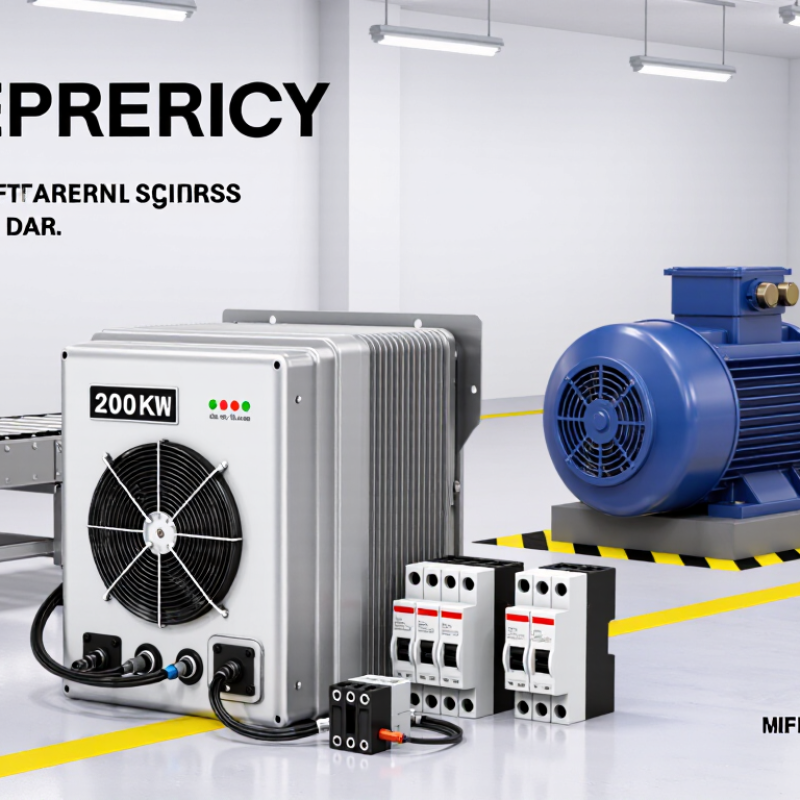
A 200 kW soft starter is an electronic device that manages the voltage supplied to a 200 kW motor during startup and stopping. It usually uses thyristors to increase motor voltage gradually, helping limit starting current and reduce sudden mechanical stress. Think of a loaded conveyor belt beginning to move without a sharp jerk. A soft starter is not a speed controller; after startup, the motor generally runs at supply frequency.
The 200 kW figure describes motor power, not a universal starter size. Selection also depends on supply voltage, motor full-load current, starting time, starts per hour, and load inertia. A pump and a crusher can behave very differently. The IEC 60947-4-2 standard covers semiconductor motor controllers and starters, while the International Energy Agency’s 2011 report, Energy-Efficiency Policy Opportunities for Electric Motor-Driven Systems, estimates that motor-driven systems use about 45% of global electricity. That broader energy figure is useful context, but it does not predict savings from a soft starter alone. That distinction is easy to miss.
Tips: Check the motor nameplate current and the actual load profile before choosing a unit. Ask for thermal and bypass details, too. Small details matter. A site engineer should verify the settings during commissioning; calculated values can be imperfect in real installations.
China Best 200kW Soft Starter Manufacturer? - What Is a 200 kW Soft Starter?
| Category | Selection Parameter | Typical Reference for a 200 kW Motor | What to Check |
|---|---|---|---|
| Purpose | Soft starter function | Gradually increases motor voltage during startup to reduce starting current and mechanical shock. | It controls starting and stopping; it is not a variable-frequency drive and does not provide continuous speed control. |
| Motor rating | Rated motor output | 200 kW (approximately 268 hp) | Confirm the motor nameplate rating and whether the application requires normal- or heavy-duty starting. |
| Electrical supply | Three-phase voltage and frequency | Common low-voltage systems include 380–415 V at 50 Hz and 440–480 V at 60 Hz. | Choose a starter rated for the actual supply voltage and frequency. These ranges are examples, not a universal specification. |
| Motor current | Full-load current (FLA) | Often approximately 340–380 A on a 400 V system; the actual value depends on motor efficiency and power factor. | Use the motor nameplate current—not motor kW alone—to select the starter. |
| Starter rating | Continuous current rating | Select a unit whose applicable motor-current rating is at least the motor nameplate current after relevant derating. | Check the manufacturer’s rating tables for ambient temperature, installation altitude, enclosure, duty cycle, and bypass arrangement. |
| Starting performance | Current limit | Adjustable limits are commonly expressed as a multiple of motor FLA; the required setting is application-dependent. | Set the limit high enough to accelerate the load reliably while keeping supply and mechanical constraints in mind. |
| Starting performance | Ramp and start time | Settings may span several seconds to tens of seconds, depending on the starter and load. | Longer acceleration can increase motor heating. Verify that the motor can tolerate the starting duty. |
| Load matching | Typical applications | Pumps, fans, compressors, and conveyors, subject to the load’s starting torque and inertia. | High-inertia or high-breakaway-torque loads may require a heavier-duty starter or another starting method. |
| Motor protection | Overload and thermal protection | Protection should be set to the motor nameplate current and the applicable motor thermal limits. | Check overload trip class, phase-loss protection, and coordination with upstream fuses or circuit breakers. |
| Installation | Cooling and enclosure | Many open-frame soft starters are intended for installation inside a suitable electrical cabinet. | Confirm ingress protection, ventilation, clearance, ambient temperature, and heat dissipation for the complete installation. |
| Selection process | Key information to provide | Motor nameplate data, supply voltage, load type, starts per hour, acceleration time, and site conditions. | Use these details to request a model-specific rating and verify compliance with local electrical standards. |