
2026 How to Choose a Steel Column Radiator?
Choosing a Steel Column Radiator in 2026 involves more than matching a finish to your interior. The correct model must deliver suitable heat, fit the available wall space, and work efficiently with your heating system. A tall, narrow radiator may suit a compact hallway, while a wider three-column model could better warm a cold sitting room.
Robert Bean, a Canadian building-science educator and registered engineering technologist, has often stressed that “comfort is more than air temperature; surrounding surfaces matter too.” That principle is useful when comparing radiators. A room may feel chilly beside an uninsulated external wall, even when the thermostat displays 21°C. Measure the room’s heat requirement in watts before choosing a radiator. Check flow temperatures, pipe centres, wall construction, and valve clearance. Small details matter.
Appearance can mislead. A polished finish does not guarantee strong performance. More columns usually create greater surface area, but size, water temperature, and installation still control actual output. Low-temperature heat pumps require especially careful radiator sizing. An undersized Steel Column Radiator may leave the room cold and force the system to work harder. That is an easy mistake.
Not every recommendation will suit every home. Existing pipework can limit your choices. Older buildings may also have uneven insulation and unusual wall dimensions. This guide explores practical selection criteria, including heat output, column depth, material quality, corrosion resistance, finish, maintenance, and installation. It also questions common assumptions, because the largest radiator is not always the best radiator. The right choice balances comfort, efficiency, durability, and honest measurements.
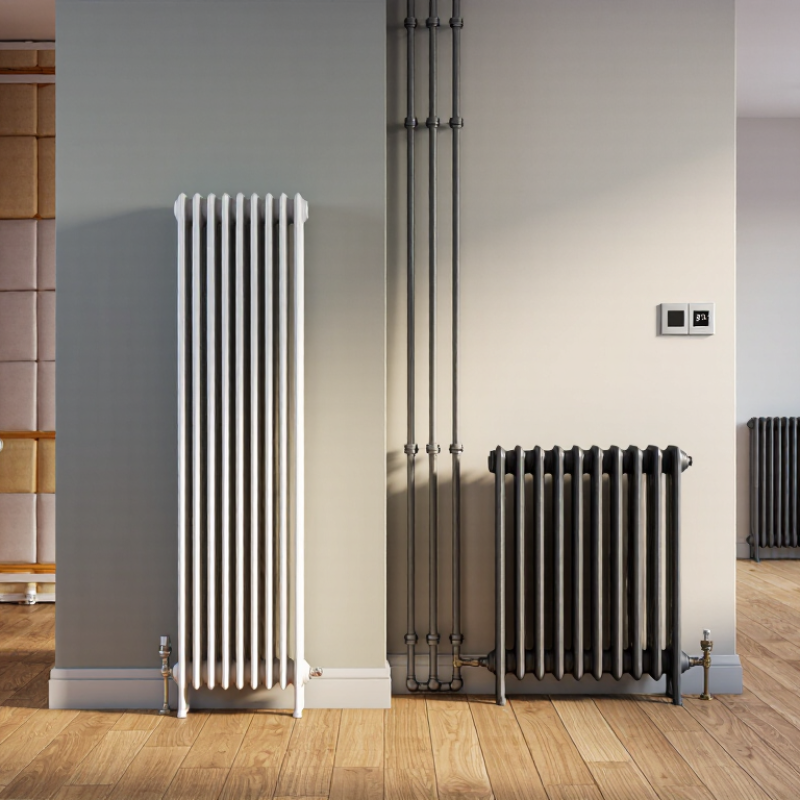
What Is a Steel Column Radiator?
A steel column radiator is a hydronic heating appliance made from joined steel tubes, called columns. These columns form vertical sections with channels for heated water. As water moves through the radiator, the steel absorbs heat and releases it into the room.
The surface warms nearby air, creating natural convection. It also provides gentle radiant heat toward walls, furniture, and people. In practical room surveys, I check the radiator’s height, depth, pipe connections, and heat output. These details affect comfort more than appearance alone. A deeper radiator may deliver more heat, but it can reduce walking space.
Steel offers useful strength and supports many traditional or modern shapes. It also holds a durable coating when properly prepared. However, steel is not completely free from corrosion. Poor water quality, trapped moisture, or damaged paint can shorten its service life. Not perfect.
When choosing one in 2026, match its tested heat output with the room’s heat loss. Consider insulation, windows, ceiling height, and local winter temperatures. Ask for performance data tested under a recognized heating standard. A qualified installer should verify pressure limits and connection compatibility. Do not rely only on section count. More columns do not automatically mean better comfort. Experiences can differ, and a radiator that suits one room may feel undersized in another.
2026 How to Choose a Steel Column Radiator? - What Is a Steel Column Radiator?
| Selection Dimension | Typical Options or Data | What It Means | Recommended Check Before Purchase |
|---|---|---|---|
| What it is | A steel radiator made from vertical hollow columns joined by horizontal headers | Hot water flows through the columns, which transfer heat to the room by convection and radiation | Confirm that the product is intended for the building’s heating system and operating conditions |
| Material | Low-carbon steel, commonly formed and welded into sections | Steel provides good strength, shape stability, and compatibility with many hydronic heating systems | Look for corrosion protection, sound welds, and a durable powder-coated or equivalent finish |
| Column configuration | 2, 3, 4, 5, or 6 columns per section are common market configurations | More columns generally increase the radiator’s depth and heat-emitting surface | Select the lowest column count that provides the required output within the available wall depth |
| Height | Common finished heights include approximately 300, 500, 600, 900, and 1,800 mm | A taller radiator normally provides more heat output for the same width and column count | Measure the wall area, skirting board height, window sill, and required floor clearance |
| Width | Available as individual sections or assembled lengths; section widths are often around 40–50 mm | The total width determines how much wall space is used and contributes directly to total heat output | Allow space for valves, pipe connections, brackets, and access for cleaning |
| Depth | Typical multi-column depths range from approximately 60 to 225 mm, depending on the design | Greater depth usually increases surface area and heat output but projects farther into the room | Check furniture clearance, walkway space, wall strength, and the position of thermostatic valves |
| Heat output rating | Usually stated in watts (W) or British thermal units per hour (BTU/h), often tested at ΔT50 | The output depends on radiator size, water temperature, room temperature, and test standard | Compare products using the same test condition; ΔT50 means a 50°C difference between mean water temperature and room air |
| Low-temperature heating | Suitable models may be used with heat pumps or condensing boilers when correctly sized | Lower water temperatures reduce heat output, so a larger radiator may be required | Request output data at ΔT30 or the actual design condition, not only the ΔT50 figure |
| System compatibility | Commonly used in sealed or open-vented hydronic systems, subject to manufacturer limits | System pressure, water quality, pipework, and controls affect service life and performance | Verify maximum working pressure, maximum temperature, connection type, and system water treatment requirements |
| Connection options | Side connections, bottom connections, or other configurations depending on the radiator design | The connection layout determines pipe routing, valve position, and installation flexibility | Match inlet and outlet positions to the existing pipework and confirm thread size before ordering |
| Installation support | Wall brackets, floor stands, air vents, drain plugs, valves, and mounting hardware may be available | Correct support is essential because steel radiators can be heavy when filled with water | Check filled weight, wall construction, fixing points, bracket quantity, and installation instructions |
| Surface finish | Primed and powder-coated finishes are widely used; white is a common standard color | The finish affects appearance and resistance to everyday moisture and abrasion | Inspect the coating for complete coverage, smoothness, and suitability for bathrooms or humid rooms |
| Maintenance | Regular dust removal, correct bleeding, leak inspection, and system pressure checks | Clean surfaces and balanced water flow help maintain efficient heat transfer | Choose a design with accessible gaps and avoid covering the radiator with curtains or furniture |
| Best use cases | Living rooms, bedrooms, hallways, offices, period-style interiors, and modern residential spaces | The vertical column appearance can provide both practical heating and a decorative feature | Prioritize output, dimensions, connection layout, and safety over appearance alone |
| Compliance information | Look for applicable test standards, technical documentation, and installation declarations | Verified performance data makes products easier to compare and specify correctly | Request documented heat output, pressure testing, dimensions, tolerances, and warranty conditions |
| Final sizing method | Room heat-loss calculation plus radiator output at the intended operating temperature | Room size alone is not sufficient because insulation, windows, external walls, and climate affect demand | Use a qualified heating professional for the final selection, especially with low-temperature systems |